This essay began on a recent vacation through Turkey and Greece. Athens was one stop, but walking through the Acropolis, the Ancient Agora, and Plato's Academy turned an abstract historical question into something I could stand inside. The photographs throughout are mine, taken in Athens on that trip.
In the Agora, I kept running into a mismatch of scale.
The site is compact. From the open ground below the Temple of Hephaestus, it is easy to imagine people crossing paths again and again: politicians and merchants, craftspeople and jurors, priests and philosophers. The names we inherit as marble busts start to look like residents of one small town. Socrates was not yet a chapter in the history of philosophy. He was a difficult man asking questions in a place where people bought fish, heard lawsuits, worshipped, argued about politics, and tried to get through the day.
The consequences don't fit inside that frame. In roughly the long century spanning the great fifth-century building program and the schools of Plato and Aristotle, Athens became central to how much of the modern world talks about politics, ethics, history, drama, rhetoric, art, and reason itself. Athens did not invent all of these things, and “Western civilization” is a messier chain of borrowing, translation, loss, and rediscovery than the phrase suggests. Even after those corrections, the concentration is remarkable.
So I found myself asking: what conditions allow an unusual amount of human potential to become consequential at once?
First, get the scale right
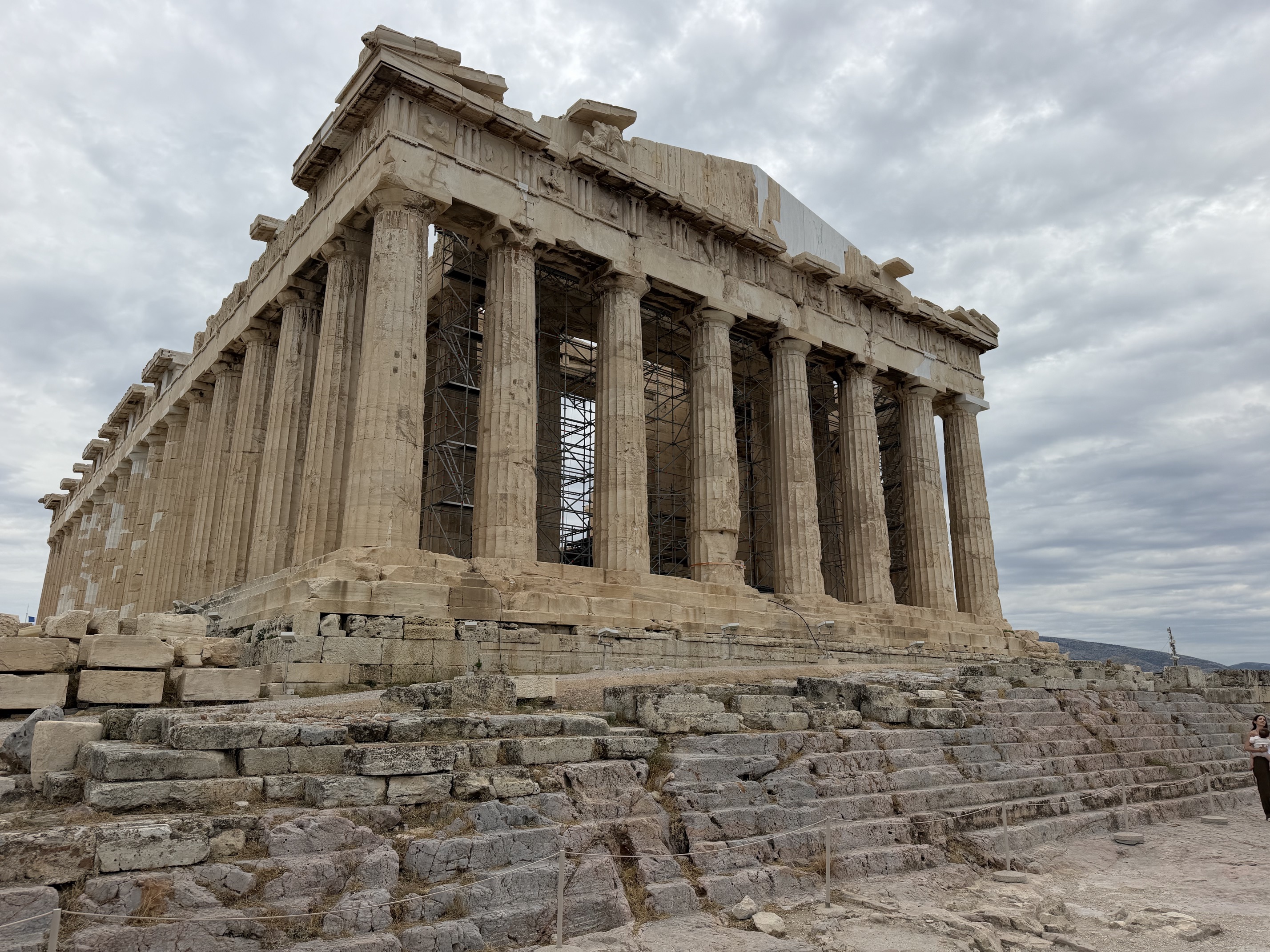 The Parthenon on the Acropolis.
Ancient population figures are estimates built from fragmentary evidence, and the answer changes depending on whether “Athens” means the urban center, the territory of Attica, citizens, or every resident. One modern synthesis puts the fourth-century adult male citizen population at perhaps 30,000 and the total population near 300,000, while emphasizing how uncertain the count of non-citizens and enslaved people remains. The useful point is not the exact number. It is that this was a society on the scale of a modest modern city, not a continent-sized civilization.
The time window is easy to exaggerate too. Classical Athens was not one uninterrupted golden age. It endured war, plague, civil conflict, oligarchic coups, military defeat, and the execution of Socrates. The people we now arrange into a single intellectual movement were separated by decades, political factions, and incompatible views. History compresses them into a group photo they never posed for.
Even with that compression removed, the ratio of output to population still feels strange. The tempting explanation is that a rare collection of geniuses happened to be born near one another. That is possible. It is also not much of an explanation.
The Agora was not a university campus
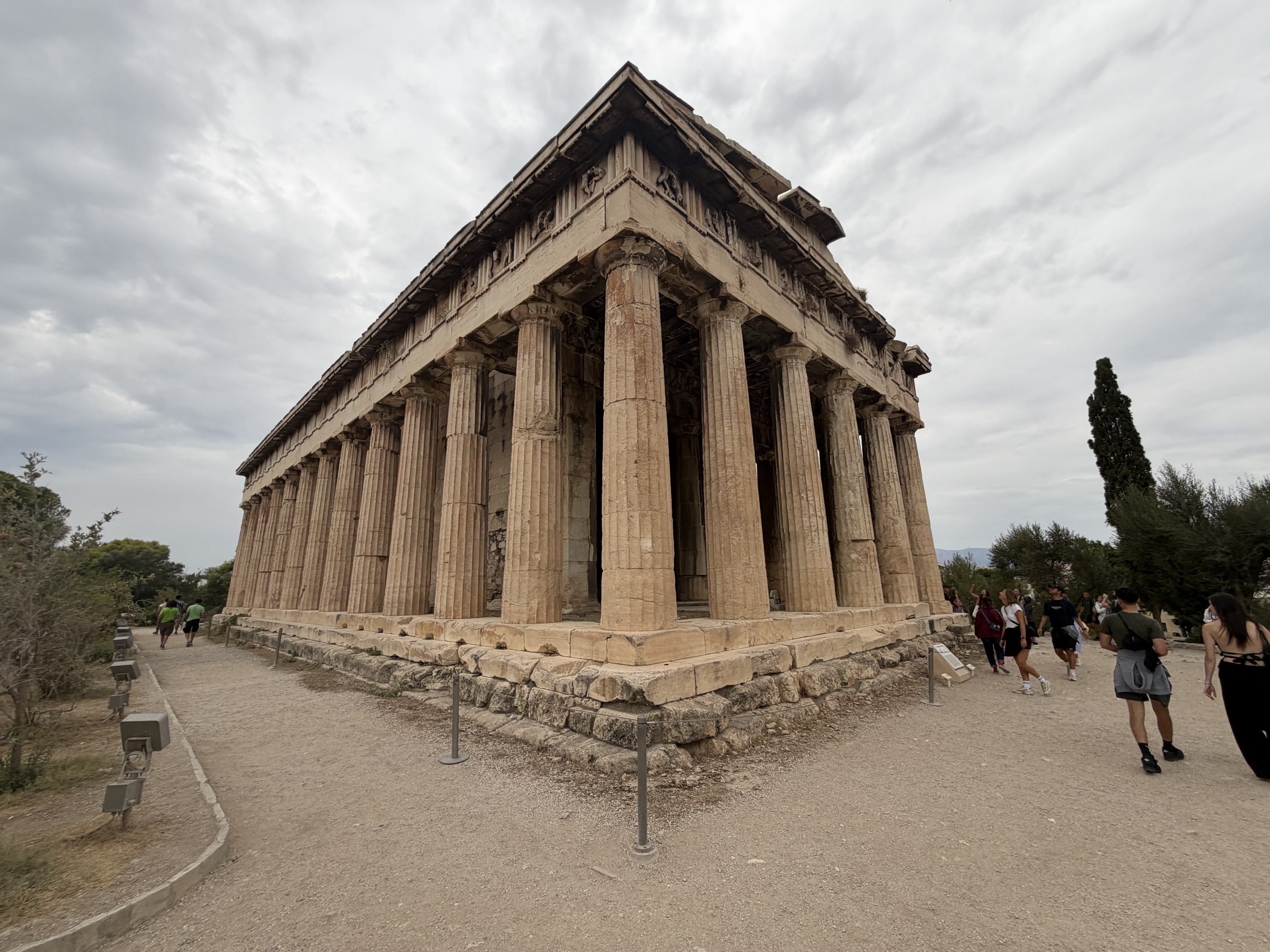 The Temple of Hephaestus in the Ancient Agora.
The American School of Classical Studies describes the Agora as Athens's civic center. Its finds include ballots and jurors' tickets, public records, weights and measures, household objects, and evidence of workshops. Another of its archaeological summaries calls the area civic, commercial, religious, and heavily industrialized. Those categories now belong in separate buildings, often in separate parts of a city. In Athens they overlapped.
That overlap seems important. The Agora did not gather only philosophers. It kept mixing people who did different kinds of work, under conditions where speech had consequences. Arguments could change a verdict, a reputation, a public decision, or a student's life. Ideas had audiences, opponents, and stakes.
I do not know how much of Athens's intellectual output can be attributed to physical density. The city was not running a controlled experiment, and a persuasive story can be assembled after the fact from almost any famous place. Still, the mechanism is plausible. If people with different knowledge collide often enough, useful ideas can move between domains. If public argument carries status, ambitious people will become good at it. If institutions create recurring audiences, a thought can be tested, remembered, improved, or attacked instead of disappearing at the end of a private conversation.
Proximity alone may not be the striking feature. Proximity plus repetition might be. Athenian public life ran through courts, assemblies, workshops, theaters, gymnasia, religious festivals, and private gatherings. How often those settings mixed the same people is hard to reconstruct. The mechanism I care about is simple: an idea could make several trips through a network and come back changed.
Talent needs somewhere to go
We often talk about intelligence as if it were stored entirely inside individual heads. That is true at one level and misleading at another. A person can have unusual ability and still lack the time, education, collaborators, tools, audience, or permission needed to turn it into work that survives.
Athens supplied some of those missing pieces. It had institutions that rewarded speech and civic participation. It had trade, wealth, literacy, patronage, and competition for prestige. It had public spaces in which claims could be challenged. It also had enough connection to the wider Mediterranean to absorb ideas, materials, and techniques that did not originate there.
None of these conditions is sufficient alone. Wealth can produce comfort without insight. Competition can produce conformity or cruelty. Dense networks can circulate nonsense faster than truth. Public argument can reward performance over understanding, and Athens offers no shortage of examples. The more useful claim is narrower: ability becomes more productive when a society gives it several routes to expression and several ways to receive correction.
That is how I now read the familiar cast of Athenian figures. Their achievements were individual, but they were not made in isolation. Plato needed his own mind, of course. He also needed teachers, rivals, students, texts, institutions, and a city where argument was already a serious public activity. The network does not replace the person. It helps explain why the person's work had somewhere to go.
The miracle had a bill
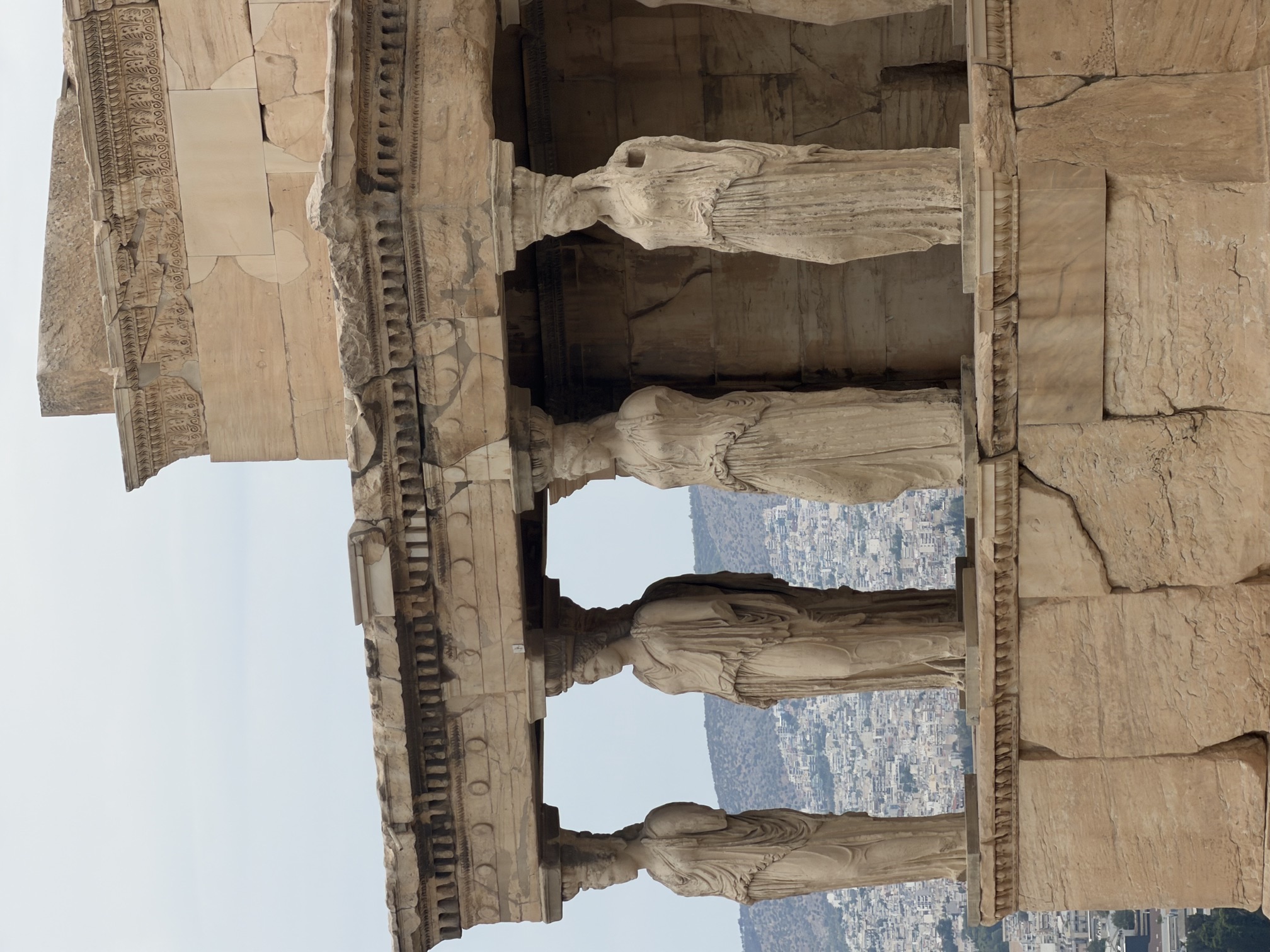 The Caryatids on the Acropolis.
Any account of Athenian flourishing becomes dishonest if it treats “the Athenians” as everyone who lived there. Formal political power belonged to a restricted body of male citizens. Women were excluded from citizenship's political rights. Metics—free resident foreigners who could be economically and culturally important—could not vote in the Assembly or serve as jurors or magistrates. Enslaved labor was not peripheral to the society; historians describe classical Athens as one of the clearest ancient examples of a slave society.
Athens was also an imperial power. Tribute and coercion were part of the material background against which its temples, festivals, and public life developed. A story about democracy and reason can become a flattering myth if it leaves out who had leisure, who performed the labor, who was permitted to speak, and who paid.
The correction shouldn't become an equally simple reversal. Slavery did not mechanically produce philosophy, and exclusion is not a recipe for genius. The better question is which enabling conditions can be separated from the injustices that accompanied them. Public argument, repeated contact, education, time, institutional support, and cultural ambition do not logically require a slave economy or a narrow definition of citizenship. If anything, widening access should expose more latent ability, not less.
Survival distorts the picture too. Athens matters partly because later societies decided that Athens mattered. Texts were copied, translated, taught, canonized, lost, recovered, and copied again. Other cities and cultures produced ideas that disappeared or were absorbed without their origins remaining attached. The influence of Athens is real, but it reflects both what Athenians made and what later people chose to preserve.
A different way to look at fragments
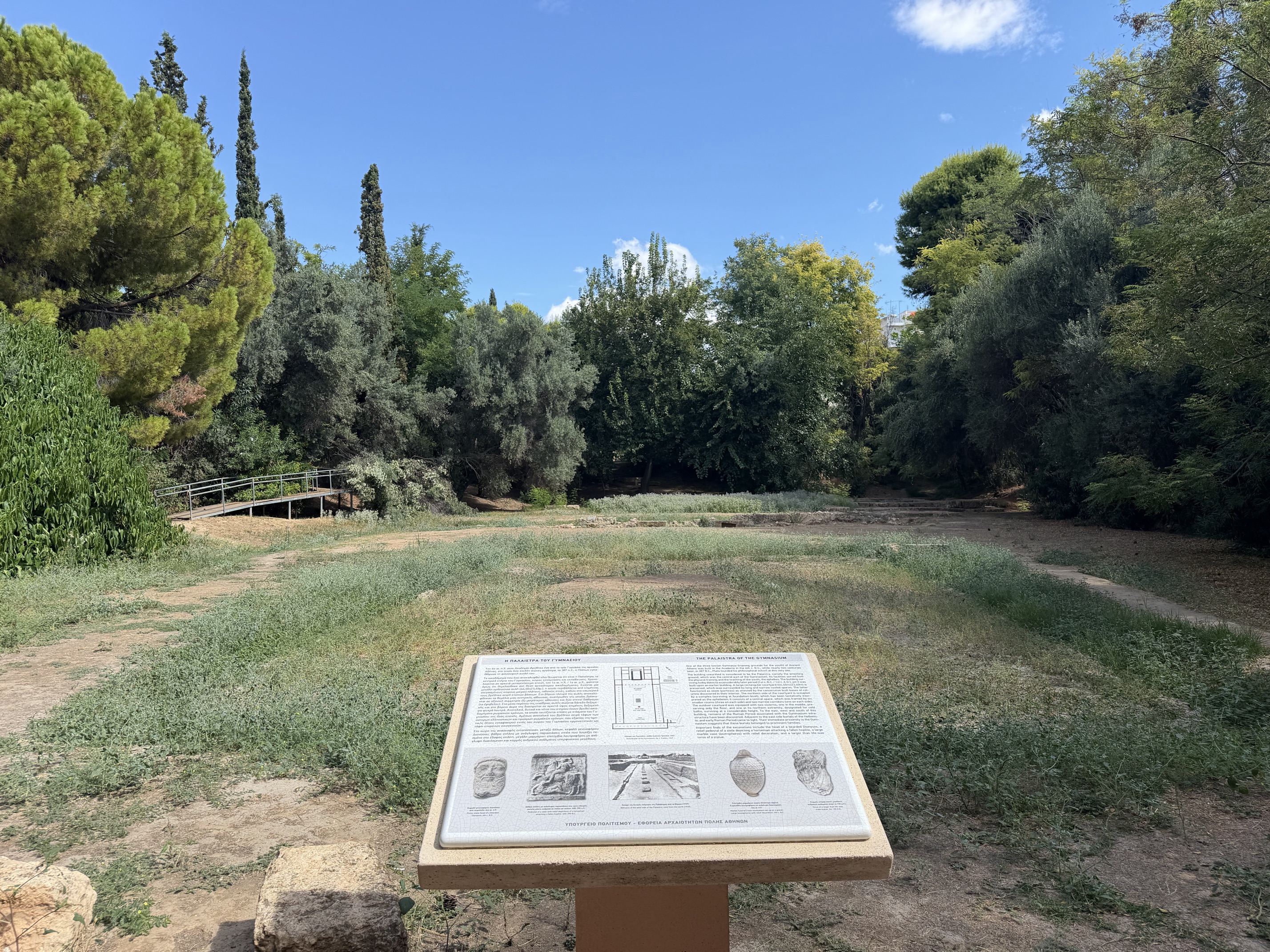 The ruins of Plato's Academy—arguably the first university in the West, and where Aristotle studied for roughly twenty years.
This is my first trip to Europe since working on Polycam, so at the Acropolis Museum I scanned some of the fragments and artifacts instead of only looking at them. It turned passive viewing into a small act of reconstruction. Both scans are below, and you can orbit them.
A scan is not the object, of course. It is another kind of fragment: a record of visible geometry that still leaves most of the original context outside the frame.
That feels like a useful model for thinking about Athens. What survives is not the civilization. It is a sparse reconstruction made from stones, inscriptions, copied texts, later testimony, and the questions we bring to them. The gaps are not an inconvenience we can polish away. They are part of the evidence.
The ruins do make one thing vivid. The people who occupied these spaces were human at our scale. They did not have a different biological capacity for argument, imagination, or curiosity. What differed was the configuration around them: institutions, incentives, habits, surplus, conflict, geography, and a network dense enough for ideas to find resistance and traction.
What are we configuring now?
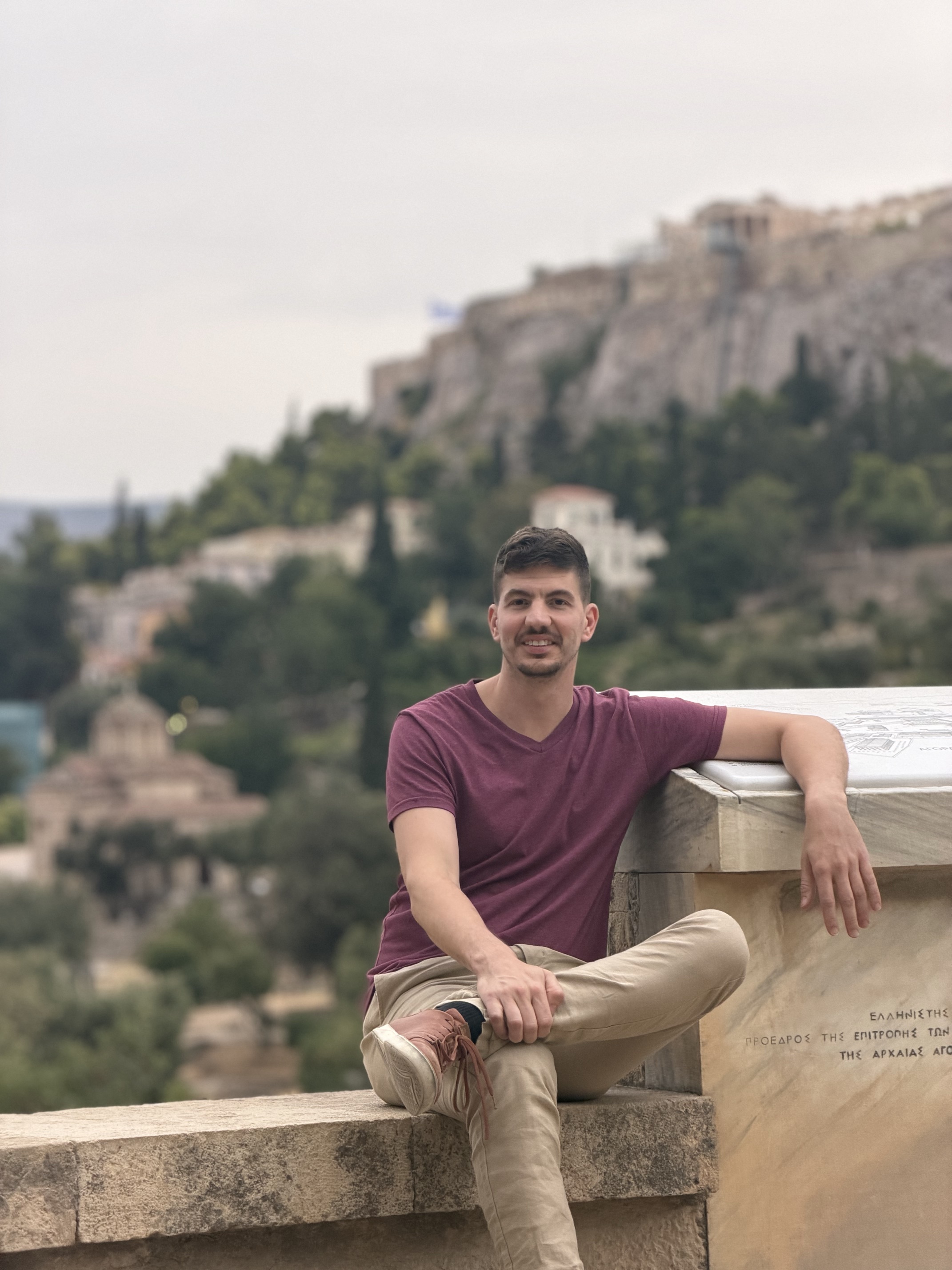 Me in the Ancient Agora, with the Acropolis in the background.
I don't want to end by proposing we rebuild the Agora, literally or metaphorically. Ancient Athens was not a design template, and modern societies are too different for the analogy to carry much weight. The practical lesson is smaller: pay attention to intellectual environments, not only individual productivity.
Who do we encounter repeatedly? Which disciplines are kept apart? Where can an unfinished idea be challenged without being instantly converted into content or a professional position? Who has time to participate, and who is excluded by the cost? Which institutions reward clarity, revision, and truth rather than confidence alone?
These questions feel more urgent as AI makes some kinds of knowledge and production far cheaper. It can widen access to explanation and hand one person a much larger set of intellectual tools. It can also remove the friction of other minds and let us produce plausible answers without public correction. The technology raises individual leverage. It does not automatically create the social conditions for better thought.
My current view is that Athens is less a story about a lost population of exceptional people than evidence about ordinary human capacity under unusual conditions. That reading is more demanding, because it turns admiration into a design problem. If potential is common and its expression is rare, the question is not where the next Socrates will be born.
It is whether we are building places in which we would notice him.
Sources and open questions
- Adriaan Lanni's Law and Order in Ancient Athens gives a concise account of the uncertainty in population estimates.
- The American School of Classical Studies documents the Agora as a center of civic activity and describes its overlapping civic, commercial, religious, and industrial uses in an interview with archaeologist Carol Lawton.
- James Watson summarizes the legal distinctions between citizens and metics in classical Athens.
- The Cambridge World History of Slavery explains why scholars classify classical Athens as a slave society.
- Thucydides records the scale of allied tribute in Athens's finances and expenditure on Acropolis buildings in History of the Peloponnesian War 2.13; the exact funding history remains debated.
- Oxford dates the Parthenon to 447–432 BCE; Cambridge dates Plato's Academy from about 387 BCE; and the Stanford Encyclopedia dates Aristotle's establishment of the Lyceum to 335 BCE. Together they bound the deliberately approximate “long century” used above.
- David Pritchard's review of Attic women supports the narrower claim that political participation in the assembly, courts, and council was restricted to adult men, while newer scholarship warns against treating political office as the whole meaning of Athenian citizenship.
- The Cambridge Intellectual History of Byzantium describes how Byzantine scholars not only preserved Greek texts but made choices that helped shape the surviving canon.
Two questions I want to return to: how well the network argument survives closer historical scrutiny, and how the account of empire and cultural transmission changes as the evidence improves.